
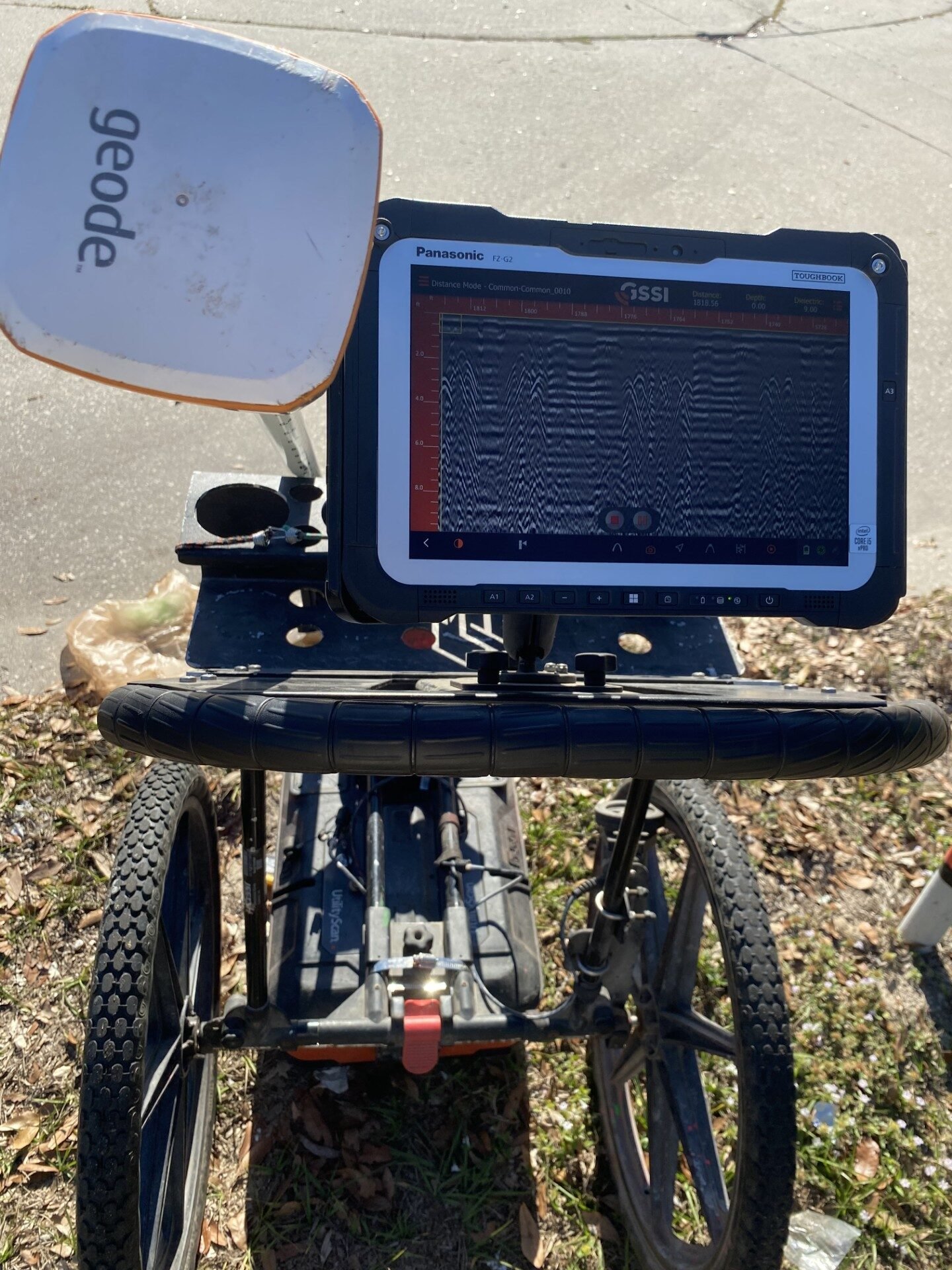
See targets that do not carry an EM signal
Ground penetrating radar sends radar energy into the ground and records reflections from buried objects and changes in subsurface materials. It is especially useful when a target is plastic, clay, concrete or otherwise non-conductive.
GroundScout uses GPR as part of a multi-method locate. EM tracing can identify conductive lines and tracer wire, while GPR investigates targets that do not respond to EM or require a second method.
What GPR may help identify
Non-metallic utilities
PVC water lines, clay sewer, plastic gas lines and other targets without a usable conductor.
Buried structures
Vaults, tanks, ducts, encasements, abandoned lines and other subsurface obstructions.
Utility corridors
Targets beneath pavement, landscaped areas and commercial sites with incomplete records.
How a GPR locate works
Review the site
The work area, expected utilities, access and surface conditions are reviewed before scanning.
Scan a controlled grid
The antenna is moved across the surface in planned passes while the operator reviews live radar profiles.
Correlate and mark
Consistent responses are compared with visible features, EM results and site context before marking.
Site conditions matter
GPR performance changes with soil type, moisture, depth, target size, surface reinforcement and nearby clutter. Florida sand often performs well, while saturated soil and conductive clay can reduce penetration. GPR does not automatically identify what every response represents; interpretation and correlation are essential.
When GPR is a strong fit
- Private utilities have no tracer wire
- Records are incomplete or conflict with field conditions
- Unknown or abandoned utilities may cross the work area
- Work is planned across pavement or developed commercial sites
- EM locating needs a second method for added confidence
GPR FAQs
Can GPR locate every underground utility?
No. Results depend on target size, depth, soil, moisture and other site conditions. GPR is strongest when used with site context and other locating methods.
Does GPR replace 811?
No. Always place the required 811 ticket first. GPR can help investigate private utilities and targets outside the public marking scope.
Can GPR provide exact depth?
GPR can support depth estimates when the radar velocity and target response are clear. Critical depth should be verified before excavation.