
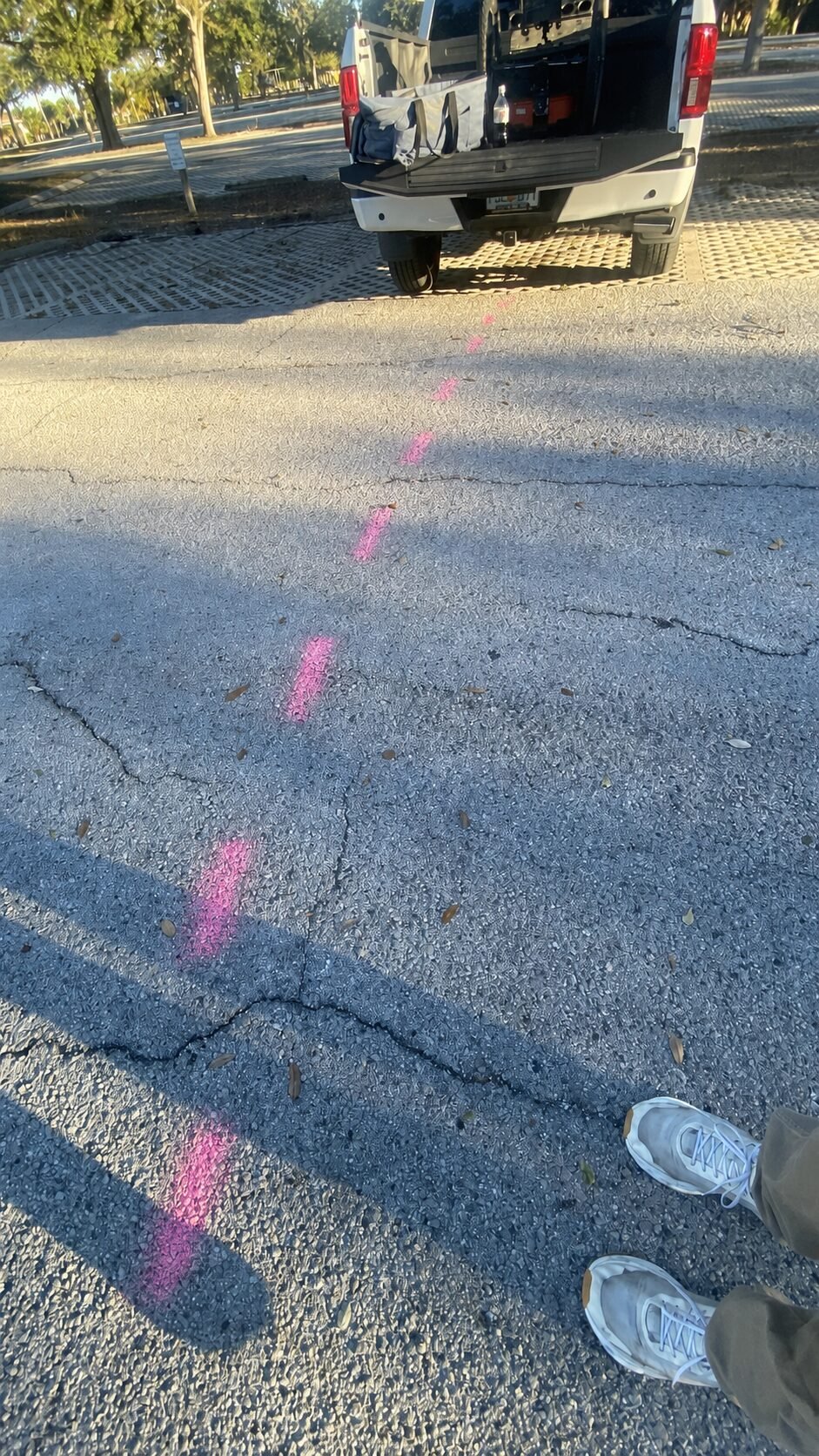
Most construction problems don’t start during excavation — they start before anyone touches the ground.
In Florida, and especially across the Tampa Bay region, underground conditions are rarely as clean as the plans suggest. Private utilities, undocumented lines, old infrastructure, and shifting soils create real risk during construction. That’s why professional utility locating plays such a critical role in the pre-construction phase.
Below are eight practical, field-tested steps that help projects start cleaner, safer, and with fewer surprises — all centered around the utility locating services GroundScout provides.
One of the most common mistakes in pre-construction planning is being too vague about excavation limits.
“Just the backyard” or “along the building perimeter” isn’t enough.
Before any locating work begins, define:
Planned trench routes
Bore paths
Foundation and footing areas
Utility tie-in points
Clear boundaries allow for more accurate private utility locating and reduce the chance of missing a critical line outside a loosely defined area.
Learn more about this process on our Private Utility Locating page.
Calling 811 is required and should always be the first step. It marks public utilities at no cost. However, in Tampa and throughout Florida, 811 typically stops at the meter or point of connection.
That leaves a large portion of underground infrastructure unaccounted for, including:
Private electric feeders
Irrigation systems
Private gas laterals
Telecom and fiber runs
Undocumented or abandoned utilities
This is where professional utility locating services become essential.
No single tool finds everything underground.
That’s why GroundScout uses a combination of:
Electromagnetic (EM) locating for tracing conductive utilities
Ground Penetrating Radar (GPR) for detecting both metallic and non-metallic utilities, conduits, and subsurface anomalies
GPR is especially valuable beneath concrete, asphalt, and in areas where utility records are incomplete or unreliable.
Learn how this works on our Ground Penetrating Radar (GPR) services page.
In real-world conditions, utilities rarely run straight, level, or at consistent depths.
It’s common to find:
Utilities installed shallower than code
Lines that change depth along the same run
Abandoned utilities left in place
Mismatches between plans and field conditions
Assuming utilities are “probably deeper than that” is how strikes happen. Professional locating verifies reality — not assumptions.
Certain areas deserve extra attention during pre-construction locating:
Near existing structures
Around easements and property lines
Areas with multiple utility crossings
Locations with past repairs or retrofits
Targeting these zones early helps reduce risk and avoids delays once excavation is underway.
Field markings are temporary. Good data lasts.
Beyond surface paint and flags, GroundScout provides utility mapping and documentation that supports planning beyond the initial locate. This includes:
GPS-referenced utility positions
Site sketches or GIS data
Notes on anomalies or conflicts
This information becomes valuable long after construction begins.
See how this supports planning on our Site Utility Mapping page.
Utility locating shouldn’t live in a single notebook or with one crew member.
Locate information should be shared with:
Excavation crews
Project managers
Engineers and designers
Property owners
Clear communication reduces confusion, rework, and last-minute changes when digging starts.
Utility locating is often viewed as a cost to minimize. In reality, it’s a form of insurance.
Compared to the cost of:
Repairing a utility strike
Delaying a project
Dealing with safety incidents or liability
Professional locating is a small investment with an outsized return.
Florida’s soil conditions, mixed public-private infrastructure, and older developments make underground conditions especially unpredictable. Projects that skip proper utility locating during pre-construction often pay for it later — in time, money, or safety risk.
Accurate utility locating helps projects:
Start with confidence
Avoid costly surprises
Stay on schedule
Protect workers and property
A successful pre-construction phase isn’t about guessing or hoping conditions match the plans. It’s about verifying what’s underground before excavation begins.
If your project involves digging — even shallow excavation — professional utility locating should be part of your pre-construction checklist.
Knowing what’s below isn’t overkill.
It’s smart construction.