
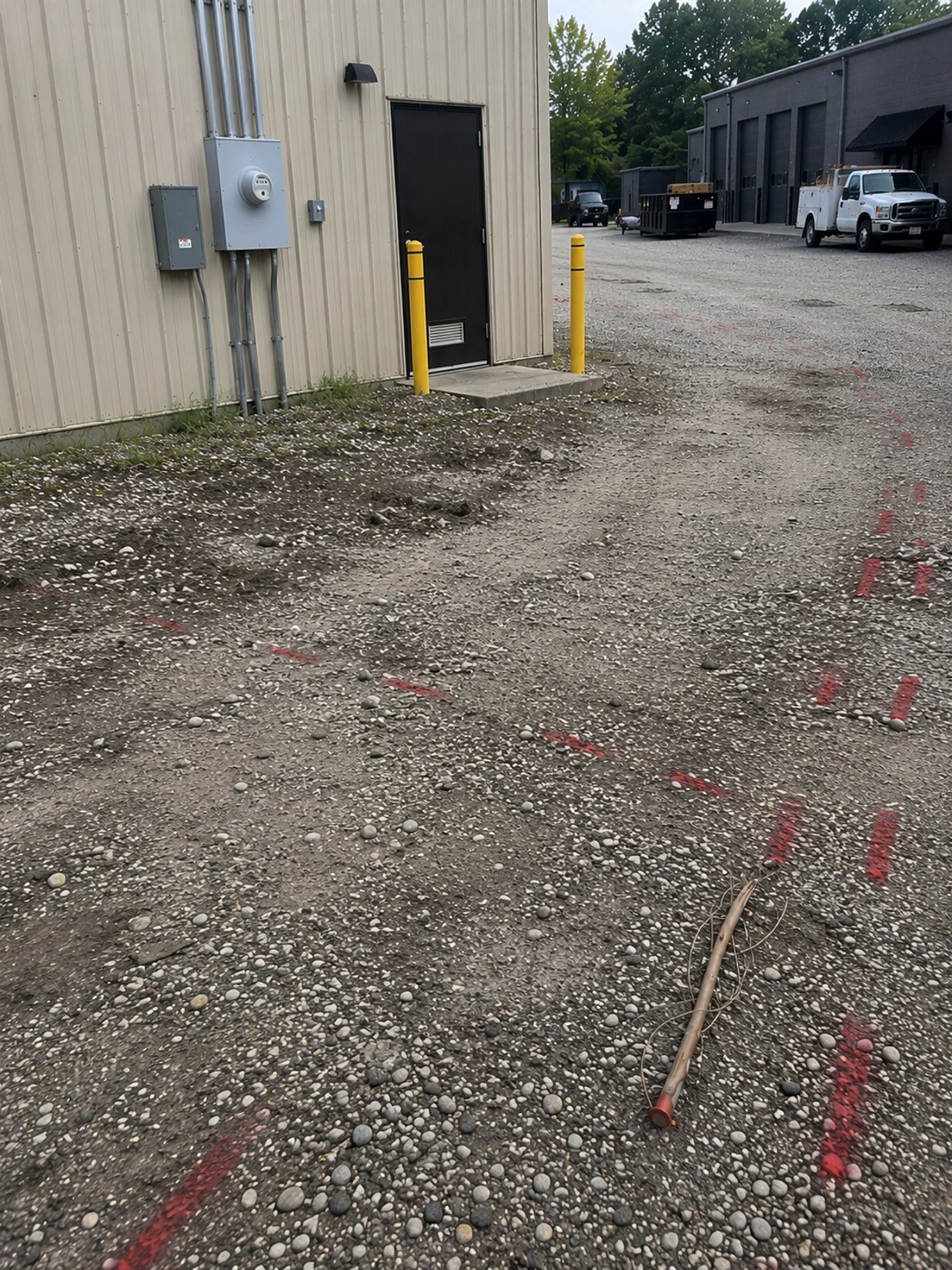
- Power company marks stop at the point of delivery, usually the meter.
- Live cable is one of the easiest targets to trace. Dead conduit is one of the hardest.
- Code minimum cover runs from 6 to 24 inches. Real depths vary.
What counts as private electric
Tampa Electric's service standards say the company does not install or repair customer-owned wiring on the customer's premises. Its 811 marks follow the same line. Everything past the point of delivery is on you:
- Feeders from the main to subpanels, shops and outbuildings
- Parking lot and site lighting circuits
- Power to monument signs, gate operators and pumps
- Pool, dock and boat lift circuits
- EV charger and generator feeds
- Low-voltage landscape lighting
These are private lines. They are not in the 811 database.
How a buried electric line is traced
Live cable
A cable carrying current gives off its own field. A receiver can pick that up from the surface. A transmitter clamped on the conduit adds a cleaner signal to follow.
Dead or abandoned conduit
No current means no field. If one end is open, a signal goes on the wire or the metal conduit. If neither end is known, radar sweeps the area for the conduit.
Lighting circuits
Lot lighting loops from pole to pole. Each pole base and handhole is a new starting point, so the whole loop gets traced one leg at a time.
Marks go down in red, the APWA color for electric. Power stays on during the work.
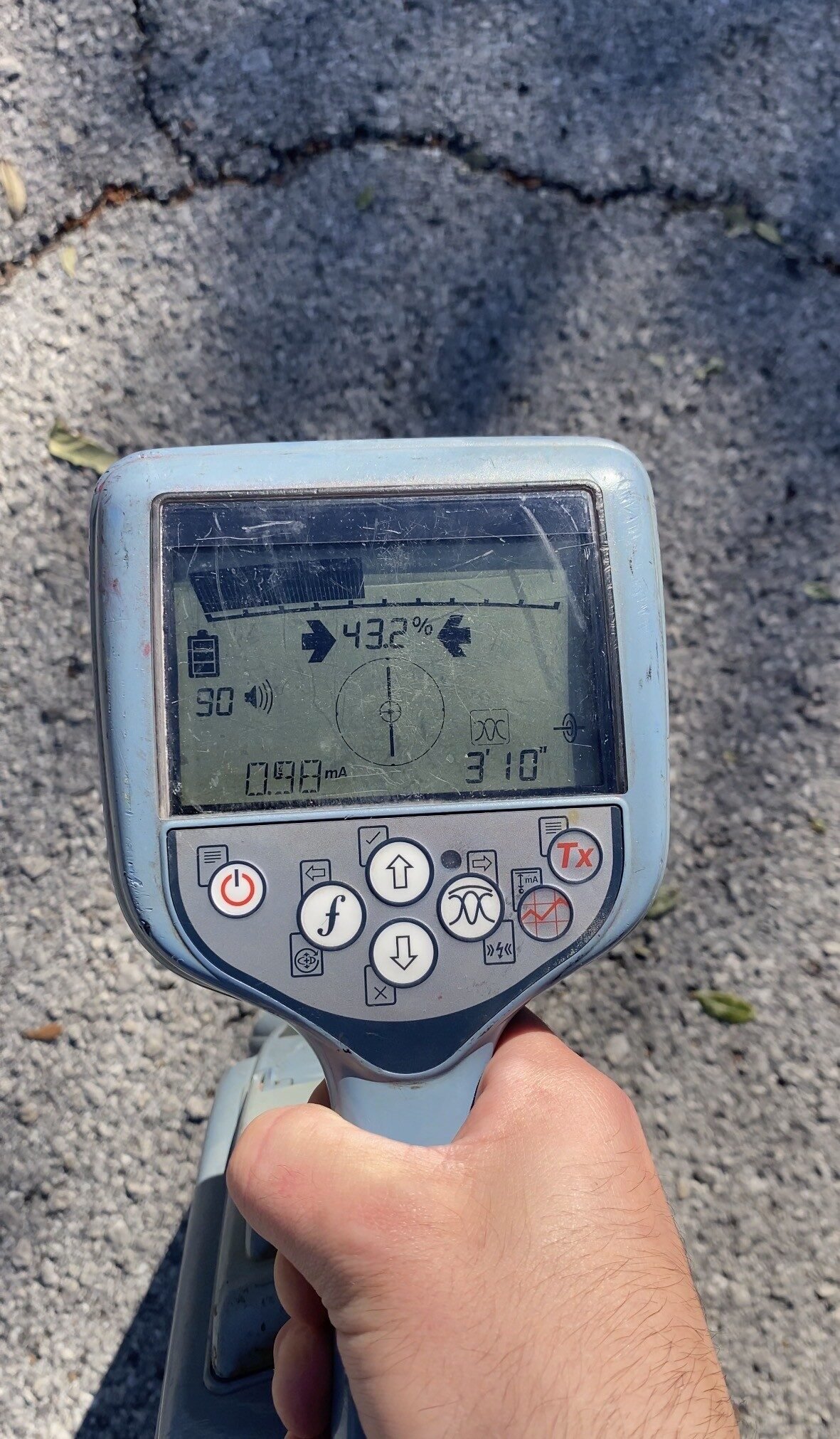
How deep buried electric is supposed to be
The National Electrical Code sets minimum cover in Table 300.5. Cover means the distance from the top of the cable or conduit to finished grade.
| Wiring method | Minimum cover |
|---|---|
| Direct-burial cable | 24 inches |
| PVC conduit | 18 inches |
| Rigid metal conduit | 6 inches |
| Home branch circuit, 120 volts, GFCI, 20 amps or less | 12 inches |
| Landscape lighting and irrigation wire, 30 volts or less | 6 inches |
Under streets, roads and parking lots, the table calls for 24 inches across the board.
These are install minimums. They do not tell you where a line sits today. Fill gets added. Grade gets cut. Older work was built to older rules. Treat every depth on a locate as an estimate.
What a locate cannot promise
- A dead line with no access at either end may not trace.
- Cables in a shared trench can pass signal to each other. Crossings get checked from both sides.
- Radar sees conduit as a target. It cannot say if the wire inside is live.
When a line cannot be confirmed, the field sketch shows the gap.
Electric line questions
Will the power company mark the line to my detached garage?
No. The utility marks its own facilities. The feed from your panel to a garage, shop or shed is customer wiring, so an 811 ticket leaves it unmarked.
Can you locate an abandoned electric line?
Sometimes. With access to one end, a signal can be put on the wire or metal conduit. With no access, radar is the only tool, and results depend on depth and soil.
Do you have to shut the power off?
No. Electromagnetic locating and radar both work from the surface. Service stays on.