
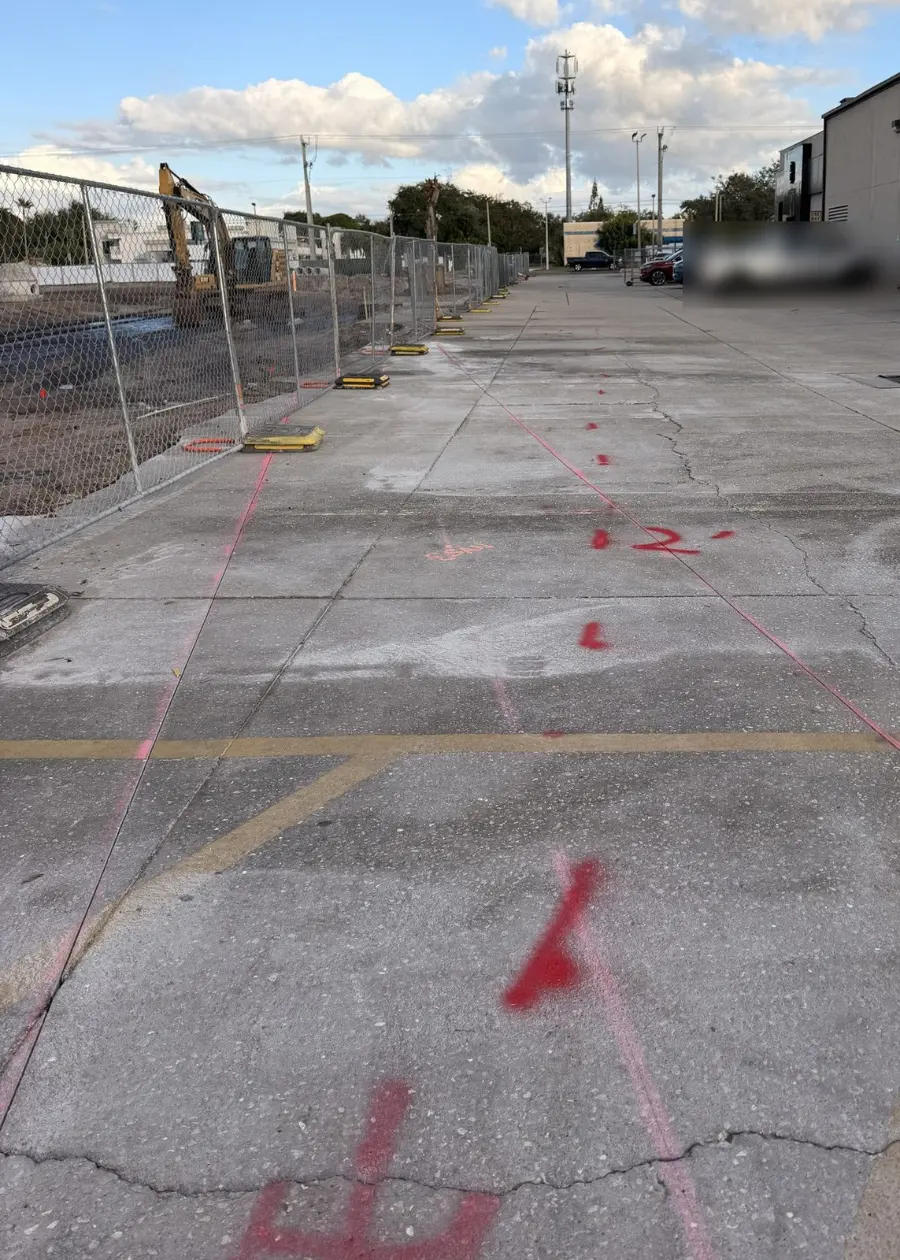
811 stops where the private lines start
On a commercial site, most of what is in the ground belongs to the owner. Power from the transformer to the building, fire lines, site lighting, storm drains, data conduit and old lines from the last tenant are all outside the 811 ticket.
GroundScout locates the work area with both EM and GPR and marks every line with paint and depth notes. Same-week scheduling is typical. On one recent job, a contractor replacing a sewer line had power, data and fire lines marked the day after sending the drawing. Read that project write-up.
What gets hit on these jobs
- Secondary power from the transformer to the building
- Fire lines, hydrant leads and backflow piping
- Phone, data and fiber conduit
- Storm drains and sanitary laterals
- Site lighting, sign feeds and abandoned lines
What the locate involves
Send the address, the drawing and the work limits. GroundScout walks the drawing against what is visible on site: transformers, meters, valves, cleanouts, backflows and pull boxes.
Then the work area gets swept with EM and ground penetrating radar. Every line gets painted in its APWA color with depth notes, so your superintendent and the excavator operator read the same marks.
On sites with demolition under way, old drawings are often wrong or missing. Abandoned lines and leftovers from the last building can show up on radar when nobody has a record of them.
What a private locate costs on a commercial site
Half day: $600
EM and GPR sweep of a trench, footing or tie-in area, paint and flags with depth notes, and a photo-documented field sketch.
Full day: $1,100
Whole-site sweeps, long utility runs or several work areas.
Maps and SUE: quoted
Drafted utility maps, CAD files for the plan set and ASCE 38 quality levels B and D are priced with the job.
You get a flat quote before the visit. A certificate of insurance and a W-9 are ready to send, so vendor setup does not hold up the job.
Why general and site contractors call GroundScout
- On site fast. Same-week scheduling is typical and next-day happens often. On the sewer-trench job, GroundScout was on site the day after the drawing came in.
- Both methods on every site. EM and GPR together, because one alone misses plastic pipe and abandoned lines.
- Marks the crew can read. Paint and flags to the APWA color code, with depth notes where the signal supports them.
- Paperwork ready. GroundScout carries general liability coverage and can send a COI before the job.
- Mapping when the spec calls for it. See utility mapping for CAD-ready files and ASCE 38 quality levels.
- Trained, not just equipped. Florida does not license utility locators. GroundScout's locator holds a Certificate of Locating Competency from Staking University.
How it works, step by step
Call 811 first
It is free and it is the law in Florida. The utilities mark the lines they own.
Send the drawing
Share the address, the drawing or site plan, the work limits and the dig date.
Get a flat quote
You get a half-day or full-day price and a date. Same-week scheduling is typical.
Walk the drawing
The plan gets checked against meters, valves, transformers and other features on site.
Sweep and mark
EM and GPR across the work area. Paint and flags with depth notes go down in APWA colors.
Dig on schedule
A photo-documented field sketch arrives the same week. A map or CAD file follows if it is in the scope.
When to schedule the locate
Before any trench, footing, bore or utility tie-in crosses ground you did not build. Book it as soon as the work limits are set, so the locate stays off the critical path.
If an inspection date is already set, say so when you call.
What affects the result
Crowded utility corridors, damaged tracer wire, deep lines, reinforced slabs and wet soil can all limit a locate. GroundScout explains those limits on site and points out where a test hole or other check makes sense before critical excavation.
Questions from general and site contractors
How fast can you get to a job site?
Same-week is typical and next-day happens often. Call instead of emailing if the excavator is already on site.
Can you provide a certificate of insurance?
Yes. GroundScout carries general liability coverage and can send a COI before the job.
What do you need from us before the visit?
The address, the drawing or site plan, the work limits and the dig date. Open electrical rooms and gates, and have someone on site who knows the property.
How much does a private locate cost on a commercial site?
A half day is $600 and a full day is $1,100. Whole-site sweeps and long runs can take the full day. You get a flat quote before the visit.
Can you put the findings on our plan set?
Yes. Findings can be drafted onto your site plan or delivered as CAD-ready files. ASCE 38 quality levels B and D are available when the spec calls for them.
Do you excavate or expose lines?
No. GroundScout locates and marks. Your crew or another contractor does the digging.
Service areas
GroundScout works across Hillsborough, Pinellas, Pasco, Polk, Manatee and Sarasota counties and the Orlando area. Local pages: Tampa, St. Petersburg, Clearwater, Largo, Palm Harbor, Brandon, Riverview, Plant City, Lutz, Wesley Chapel, Land O' Lakes, New Port Richey, Lakeland, Winter Haven, Bradenton, Lakewood Ranch, Sarasota, Venice and North Port.