
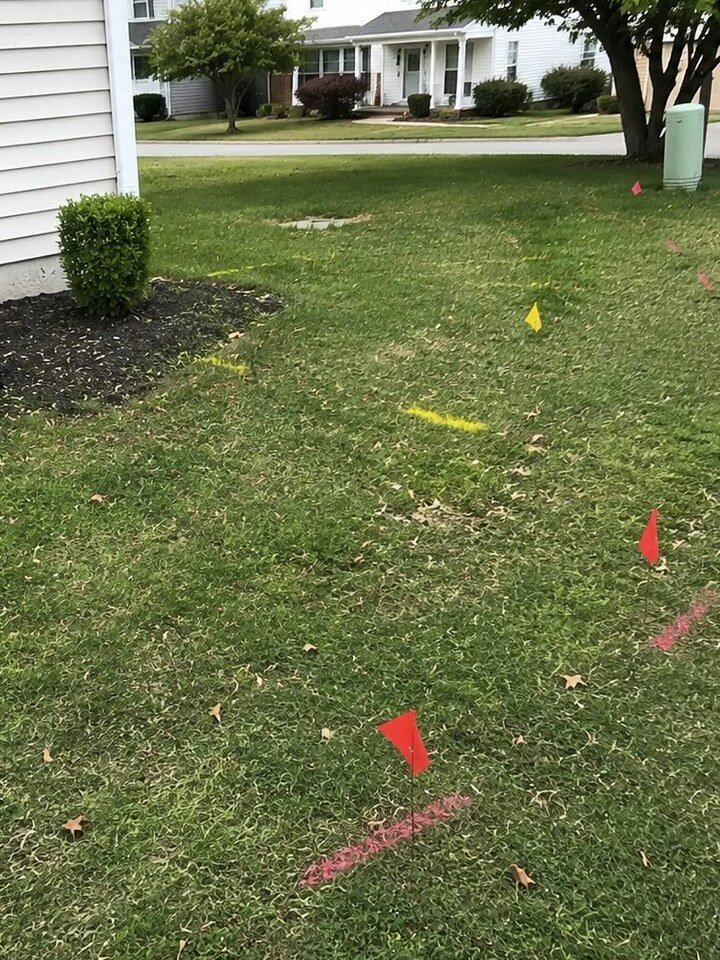
- Gas utilities mark what they own, up to the meter. Piping after the meter belongs to the customer.
- A buried line from a propane tank is fully private. No 811 ticket covers it.
- Federal rules say buried gas piping should be located before digging, and the digging done by hand.
Two kinds of private gas line
Propane. A tank feeds a buried line to the house, a generator, a pool heater or an outdoor kitchen. No utility owns any part of it. Older runs are often copper tubing. Newer ones are often polyethylene.
Natural gas past the meter. The utility's service line ends at the meter. After that, the piping to pool heaters, generators, grills and fire pits is customer piping. No utility marks it.
What the federal rule tells customers
Under 49 CFR 192.16, a gas utility that does not maintain the customer's buried piping has to say so in writing. The notice covers five points. Two matter for anyone with a shovel:
- Buried gas piping should be checked for leaks from time to time, and for corrosion if it is metal.
- Before digging near buried gas piping, the piping should be located first. The digging should be done by hand.
The same rule says plumbers and heating contractors can help locate and repair that piping. So can a private locator.
How a gas line is located
Metal pipe
Copper and steel carry a locating signal from end to end. An electromagnetic locator follows it and gives a depth estimate.
Plastic pipe with tracer wire
Plastic pipe carries no signal, so installers bury a wire beside it. Federal rule 49 CFR 192.321 requires that on utility-installed plastic gas pipe. When the wire is intact, the line traces well.
Plastic pipe with no wire
A broken or missing wire leaves radar as the only tool. Small pipe in wet ground is a hard target. If the line cannot be confirmed, you will know before anyone digs.
Gas marks go down in yellow.
Do not trust depth
Federal rules set minimum cover for a utility's service line at 12 inches on private property and 18 inches in streets and roads. Those numbers apply to the utility's pipe on the day it was installed.
Yard lines to a grill or heater were put in by whoever built the feature. A locate gives a position and an estimated depth. Hand dig to expose the pipe before any machine works near it.
If a line is hit
Stop work and move everyone away. Florida law requires an immediate 911 call when gas escapes from a damaged line. Then call the gas company or the propane supplier.
Gas line questions
Does the gas company mark the line to my pool heater?
No. The utility marks its own pipe, which ends at the meter. The branch to a pool heater, grill or generator is customer piping.
Who marks a buried propane line?
Nobody, unless you hire it. Propane lines have no utility owner and no 811 coverage. A private locator marks them. Your propane supplier may also have install records.
Can you find plastic gas pipe?
Yes when the tracer wire is intact. Without a wire, radar can sometimes find it. Depth, pipe size and soil decide.