
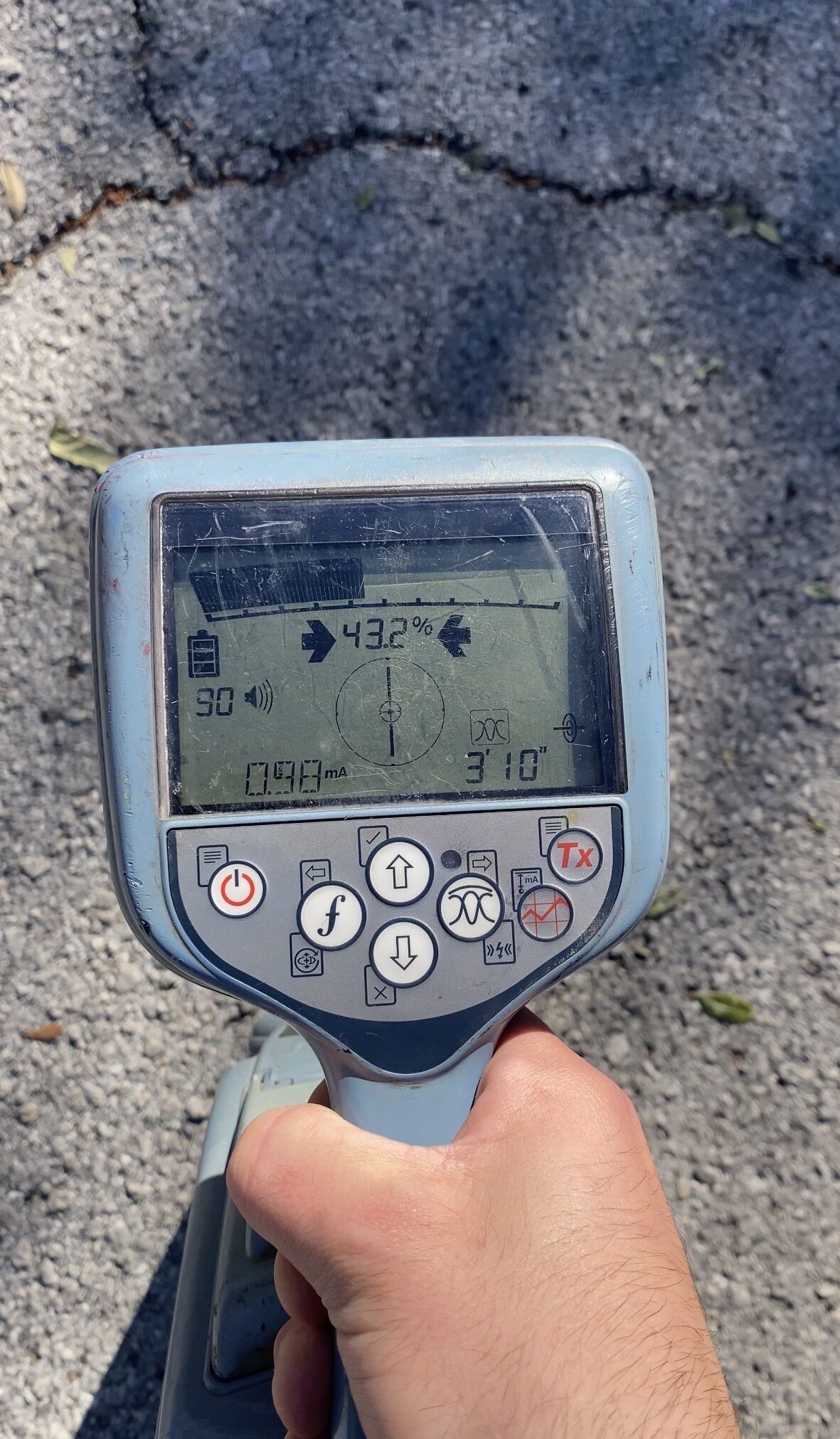
If you’ve ever watched a crew hesitate before the first bucket goes in, you’ve seen the real “preconstruction suspense” moment: What’s actually down there? Electromagnetic utility locating (often called EM locating, pipe-and-cable locating, or electromagnetic line locating) is one of the fastest, most practical ways to trace conductive underground utilities—without digging a single exploratory trench.
Below is a field-friendly breakdown of why EM locating is used, what it’s best at, and how it reduces risk on everything from small residential projects to large industrial sites.
What EM utility locating is (in plain English)
EM locating works by detecting an electromagnetic field around a utility line. That field may already exist (for example, power cables carrying current), or it can be intentionally applied using a transmitter that places a known signal onto a conductive utility (or onto a tracer wire). A receiver then follows that signal to map the line’s path.
There are two common approaches:
Passive locating: listens for naturally occurring signals (commonly power or re-radiated signals).
Active locating: applies a controlled signal using a transmitter—generally preferred when possible because it helps isolate the target line.
Why EM locating is so useful: 10 practical advantages
1) Non-destructive visibility before excavation
The obvious win: you can trace utilities without disturbing the ground, reducing the chance of costly strikes and delays.
2) Fast setup, fast answers
Compared with many investigative methods, EM locating is typically quick to deploy: confirm access points, apply (or detect) a signal, trace the route, and mark it out. In preconstruction, speed is money—and also sanity.
3) Strong performance on conductive utilities
EM shines on utilities that are metallic or have tracer wire, including many gas, water, electrical, telecom, and some duct-bank configurations.
4) Ability to “pick a line,” not just “find something”
Active EM work lets you put a specific frequency on a target conductor and trace that line—especially helpful in congested corridors where “there are lines everywhere” isn’t actionable. CGA best practices emphasize using the lowest frequency and lowest power that still completes the locate, because it can reduce distortion and unintended coupling.
5) Depth estimation in the right conditions
Many EM systems can provide depth estimates when the signal is well-applied and the locate is performed correctly—typically more reliable when you have a good connection to the target conductor (direct connect or clamp), and the field conditions cooperate.
Field note: depth readings are estimates, not promises. Treat them like a weather forecast, not a deed restriction.
6) Works on many surfaces and environments
EM locating can be performed across varied jobsite surfaces—including paved areas and tight access locations—since you’re tracing a field, not physically exposing the utility.
7) Useful for finding access points and “lost” infrastructure
EM locating can support locating access points (like valves, hydrants, or other tie-ins) and can be paired with inspection workflows (for example, using camera/sonde methods in piping contexts) to pinpoint otherwise hard-to-find features.
8) Great for progress checks during excavation or drilling
As excavation advances—or when directional drilling is in play—EM locating can help keep crews aware of nearby utilities and confirm alignment assumptions before a critical move.
9) Flexible signal application options
Signal can be applied in several ways depending on access and site constraints:
Direct connection (often best control)
Induction clamp/coupler
Induction (broadcast) when you can’t physically connect
That flexibility is huge on real sites, where “perfect access” is mostly a myth.
10) Complements GPR instead of competing with it
EM locating and ground-penetrating radar (GPR) are frequently used together because they solve different problems. EM is strong for conductive lines; GPR can help identify non-conductive utilities (like many plastic pipes) and provide additional context—so pairing them often improves confidence.
When EM locating is the best choice
EM locating is often the go-to when:
You expect metal pipe/cable or tracer wire
You need to trace a line over distance (not just detect “something nearby”)
The site is congested and you need better isolation than a broad scan
You need quick marks for planning, potholing strategy, or safe dig alignment
Common limitations (and how pros reduce the risk)
EM locating is powerful—but not magic. The most common challenges include:
Non-conductive utilities without tracer wire (some plastics, clay, concrete) may not respond well to EM alone.
Signal bleed, coupling, or distortion in congested areas can cause mis-tracing if frequency/power choices are sloppy. CGA guidance to use the lowest workable frequency/power is partly about minimizing these issues.
Depth accuracy varies with soil conditions, signal quality, and technique—depth should be verified by safe exposure methods when stakes are high. (CGA best practices broadly emphasize following established damage-prevention practices.)
A simple, “good practice” EM locating workflow
A typical professional approach looks like this:
Start with available records & site context (as-builts, utility maps, visual indicators).
Passive sweep to catch obvious energized lines and get situational awareness.
Active locate whenever possible (direct connect or clamp preferred; induction when you must).
Use conservative frequency/power settings and step up only if needed.
Trace, confirm, and mark with repeatable checks (peak/null verification, cross-check from different angles).
Recommend verification (potholing/hand exposure) in conflict zones, crossings, and critical dig areas per industry best practices.
EM locating terminology you’ll hear on site
Transmitter / receiver: the “signal source” and the “signal tracker.” simspec.org
Frequency: the signal setting; lower frequencies often improve control on the target line.
Induction / direct connect / clamp: common ways to apply signal.
FAQ
Is EM locating safe for underground utilities?
When performed correctly, EM locating is non-destructive and widely used specifically because it helps reduce damage risk.
Will EM locating find every utility?
Not necessarily. It performs best on conductive utilities (or lines with tracer wire). Pairing EM with other methods (often GPR) can improve coverage depending on the site.
How deep can EM locating detect?
Depth depends on many factors (utility type, signal strength, soil, congestion, technique). Many systems provide depth estimates, but verification is important for critical excavation.
Bottom line
Electromagnetic utility locating is popular for a reason: it’s fast, non-destructive, and highly effective for tracing conductive utilities—especially when technicians follow disciplined practices around signal application, frequency, and verification.
Note: GroundScout does not provide geophysical, geological, land surveying or engineering services. If you need such services, please contact an appropriate professional.