
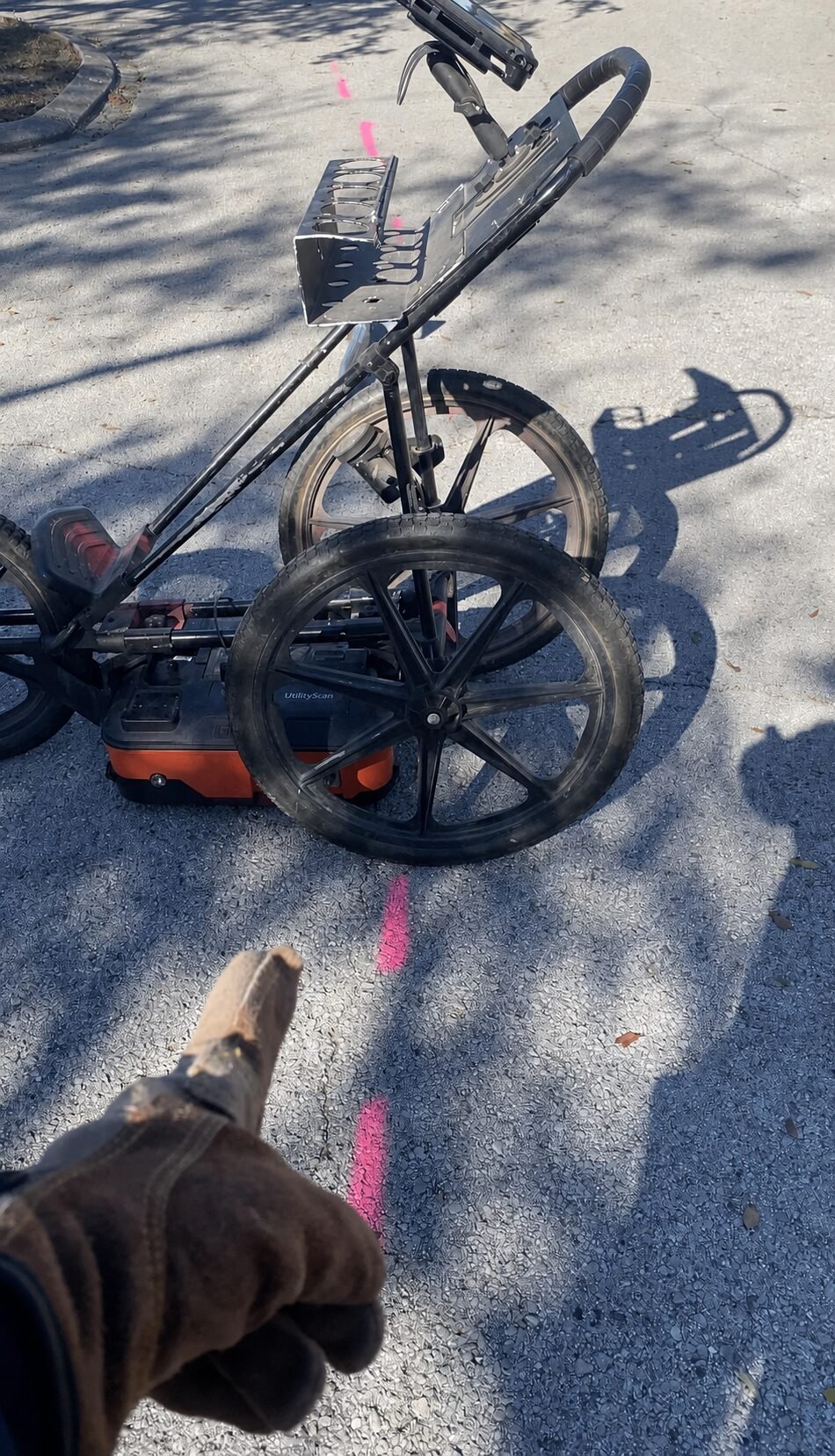
Most people do the right thing and call 811 before digging. The problem is… a “marked site” can still be a risky site. That’s because private utilities—customer-owned lines that run across a property—often aren’t included in standard one-call marking. The result is a common (and expensive) misunderstanding: “We called 811, so we’re good.” Not always.
At GroundScout, this is exactly why Private Utility Locating Services exist: to help you identify the utilities that don’t show up in the usual process, reduce strike risk, and give you documentation you can actually use for planning—not just paint on the ground.
What counts as a private utility?
A private utility is typically any underground line not owned/maintained by the public utility provider. Think power feeds past the meter, privately installed telecom runs, site lighting, irrigation, private water and sewer laterals, storm lines, and other “it was added sometime in the last 30 years” infrastructure. The details vary by site, but the key takeaway is consistent: privately owned lines may not be captured in public utility records or one-call workflows.
Some industry sources estimate that private lines represent a significant share of buried infrastructure on many properties, which is why private locating comes up constantly on commercial sites.
Why calling 811 is necessary—but not the whole solution
Calling 811 is still the first move in damage prevention. It connects you to your local one-call center and notifies participating facility operators. But the 811 center and participating utilities generally won’t notify or mark privately owned service lines/facilities if those owners/operators aren’t members, and many 811 programs explicitly communicate that private facilities may exist and won’t be located.
In plain terms: 811 helps with public utilities and participating operators. Private utilities are often on you—the property owner, GC, or project manager—to locate before excavation.
The biggest challenges of locating private utilities
1) The “no one knows” record problem
Private utilities are frequently installed, modified, repaired, or abandoned without clean as-builts. Ownership changes hands, tenants come and go, and suddenly the only “map” is a maintenance guy’s memory from 2014. Lack of reliable documentation is one of the main reasons private utility locating exists in the first place.
2) Mixed materials, mixed detectability
Private lines can be metal, plastic (PVC/HDPE), clay, concrete, or composite—and they can be shallow, deep, or stacked in the same corridor. This matters because some locating tools rely on conductivity, while others detect contrasts in subsurface conditions. When the site is a mixed bag, the locating approach has to be one too.
3) Congestion and interference in developed areas
In busy corridors, signals can couple onto adjacent conductors and nearby infrastructure can distort readings. On properties with dense utility networks, the challenge isn’t just “finding a line”—it’s correctly identifying which line you’re tracing and whether it’s the one you care about.
4) Access constraints and site logistics
Private utility work often requires coordinating access to locked areas, yards, secured facilities, mechanical rooms, or tenant spaces. Even on open sites, landscaping, pavement, traffic, and active operations can limit where and how locating can be performed safely and efficiently.
How GroundScout reduces these challenges on real projects
A dependable private utility locate isn’t one tool and a prayer—it’s a process.
GroundScout typically starts with site context (available plans, visible indicators, utility appurtenances, and likely tie-in locations), then applies the right detection stack. Electromagnetic locating (EM) is often used to trace conductive lines or tracer wire paths, especially for power and telecom runs.
When the site includes non-conductive utilities or the corridor is complex, we may recommend pairing EM with GPR utility locating. GPR is commonly used in modern utility locating because it can help identify subsurface features that don’t carry an electromagnetic signal the way metallic lines do (with site-specific limitations like soil conditions).
Why mapping matters more than most people expect
Paint and flags are helpful today. Documentation is helpful for years.
That’s why many clients choose Utility Mapping (PDF/GIS)as part of the deliverable. A clear map helps your team coordinate trades, plan future upgrades, reduce rework, and avoid “we already paid to figure this out once” moments. It also supports smarter verification planning—highlighting likely conflict zones, crossings, and areas where additional confirmation is worth it.
Best practices when private utilities are likely on site
Even if your project is small, a few habits dramatically reduce risk. Always start by calling 811, but treat that as the baseline—not the finish line. If the property is older, has multiple buildings, has had renovations, or includes site lighting/irrigation/storm infrastructure, assume private lines exist until proven otherwise. And if excavation is ongoing, continue paying attention—discoveries happen mid-project, and best-practice guidance encourages reporting mismarked or unmarked facilities through proper channels.
Bottom line
Private utilities are one of the biggest sources of “surprise infrastructure” on a jobsite because they’re often undocumented, varied in material, and outside what 811 typically marks. The fix is not guesswork—it’s getting the right locating approach early and documenting results so the whole team can build with confidence.
If you’re planning excavation, drilling, or site improvements, GroundScout Private Utility Locating Services can help you identify private lines, reduce strike risk, and deliver Utility Mapping (PDF/GIS) that stays useful long after the trench is closed.