
Calling 811 is a smart first step before digging. But it’s not the whole picture. The most common “gotcha” on jobsites—especially commercial properties—is private utilities: customer-owned lines that live on the property and often aren’t included in the standard one-call marking process. That’s where projects get expensive in a hurry, because a site can look “cleared” and still have critical utilities hiding in plain sight underground.
Private utility locating exists for one reason: to reduce the risk of strikes, delays, and rework by identifying the utilities that standard marking often doesn’t cover. At GroundScout, this is exactly what we do through private utility locating services—and when clients want documentation that stays useful beyond the job, we support that with utility mapping.
What are private utilities?
“Private” doesn’t mean mysterious—it means owned and maintained by the property owner (or a private operator), rather than the public utility company. Depending on the site, private utilities can include power feeds beyond the meter, telecom and fiber runs, site lighting, irrigation, private water and sewer laterals, storm lines, fire lines, and all the “add-ons” a property collects over decades of renovations and tenant changes.
In other words: if it was installed on the property to serve the property, there’s a good chance it’s private—and there’s also a good chance it isn’t marked the way you assume it will be.
Why 811 isn’t enough by itself
811 notifies participating utility operators and initiates public utility marking in accordance with local rules. That’s essential. The issue is that privately owned lines may not be part of that process. Many sites have utility segments that transition ownership at a meter, demarcation point, or property boundary. Past that point, it can become the owner’s responsibility—not just to repair, but to locate before disturbing the ground.
That’s why the “we called 811” checklist item sometimes creates a false sense of security. You did the right thing, but you may still be missing the lines that cause the biggest headaches.
The real cost of not locating private utilities
The obvious risk is striking a line. The less obvious risk is everything that comes with it: downtime, emergency repairs, schedule slip, change orders, tenant disruption, and liability exposure. Even a “small” strike can turn into a major problem if it shuts down operations or triggers a cascading delay across trades.
There’s also the cost of uncertainty. When crews don’t trust what’s underground, they move slower, pothole more than necessary, or redesign midstream. Private utility locating helps replace uncertainty with a plan—so excavation can be targeted, verification can be strategic, and projects can stay on schedule.
Why private utilities are harder than public ones
Private utilities are often harder to locate for three reasons: documentation, materials, and site complexity. Documentation is frequently incomplete because private lines get installed and modified over time without clean as-builts. Materials vary widely, including plastic lines without tracer wire that aren’t easy to trace using electromagnetic methods alone. And on developed properties, utilities are congested—multiple corridors, multiple reroutes, abandoned lines, and “mystery” installs that never made it onto any drawing.
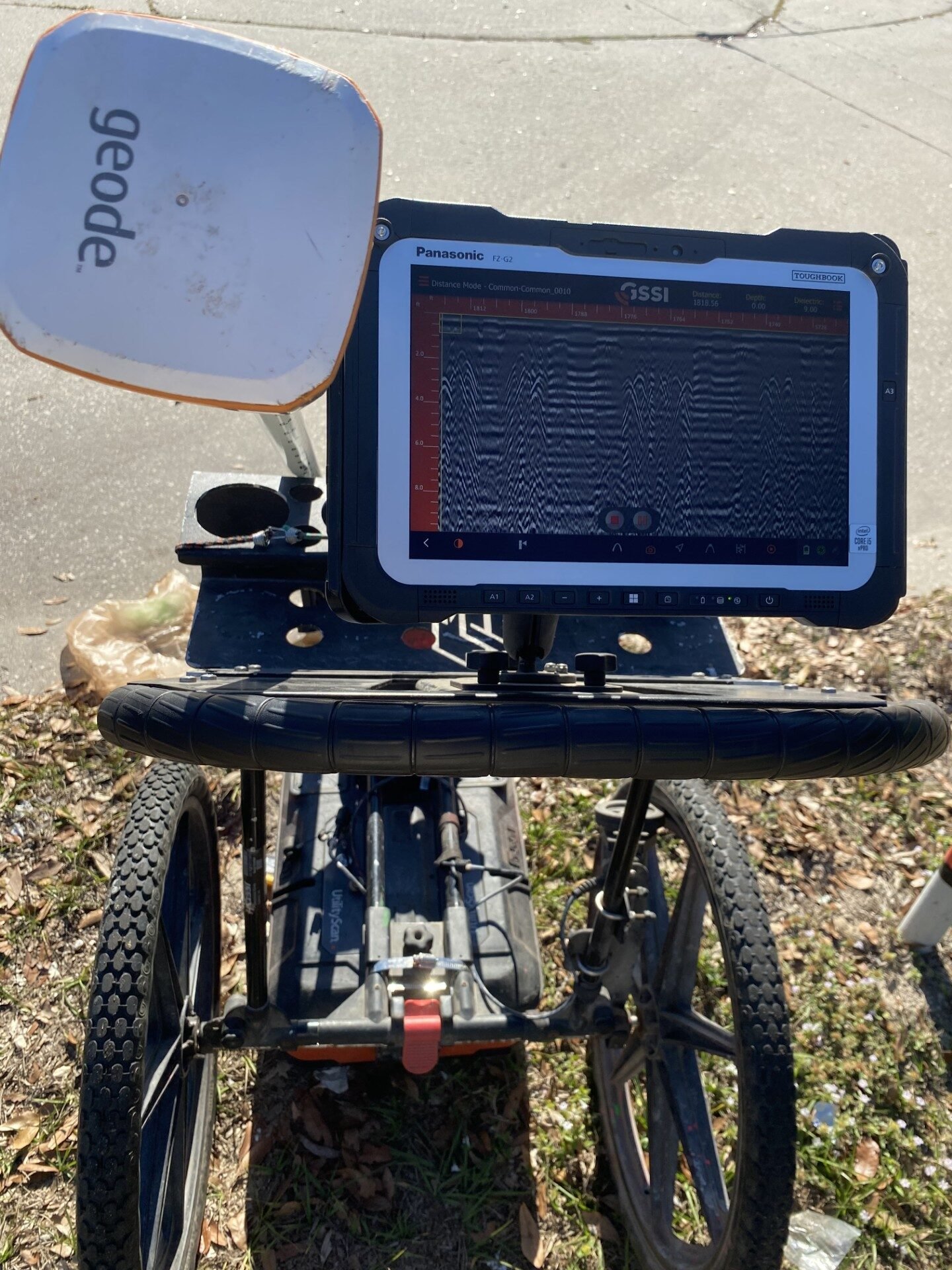
This is why professional private locating often uses a tool stack rather than a single method. Electromagnetic locating can be excellent on conductive lines and tracer wire, while GPR utility locating can help add confidence when non-conductive utilities are likely or when subsurface conditions are complex.
When you should locate private utilities
If you’re excavating on a property with multiple buildings, older infrastructure, tenant improvements, site lighting, irrigation, or prior renovations, private utilities are very likely present. It’s also smart to locate private utilities when planning directional drilling, adding signage or poles, repairing water leaks, installing drainage, building additions, or doing any work in utility-heavy corridors near parking lots and landscaped islands.
A good rule: if a strike would be expensive, disruptive, or dangerous—locate first.
The overlooked benefit: mapping that prevents repeat discovery
One of the most valuable outcomes of private utility locating is what happens after the job. If you only mark the ground, that knowledge disappears with time, weather, and resurfacing. If you capture it as documentation, you create an asset the property can use repeatedly.
GroundScout clients often choose utility mapping because it turns field locating into a shareable record that supports future projects, maintenance planning, and smoother coordination across teams. It’s how you stop paying over and over to rediscover the same underground layout.
Bottom line
Private utilities are a major source of jobsite surprises because they’re often undocumented, inconsistent in material, and outside the scope of standard public marking. Locating them reduces the risk of strikes, speeds up planning, and protects schedules. And when you pair locating with utility mapping, you don’t just solve today’s problem—you make the next project easier too.
If you’re planning excavation or site improvements, GroundScout can help you identify private utilities, reduce risk, and—when needed—support additional confidence through GPR utility locating.