
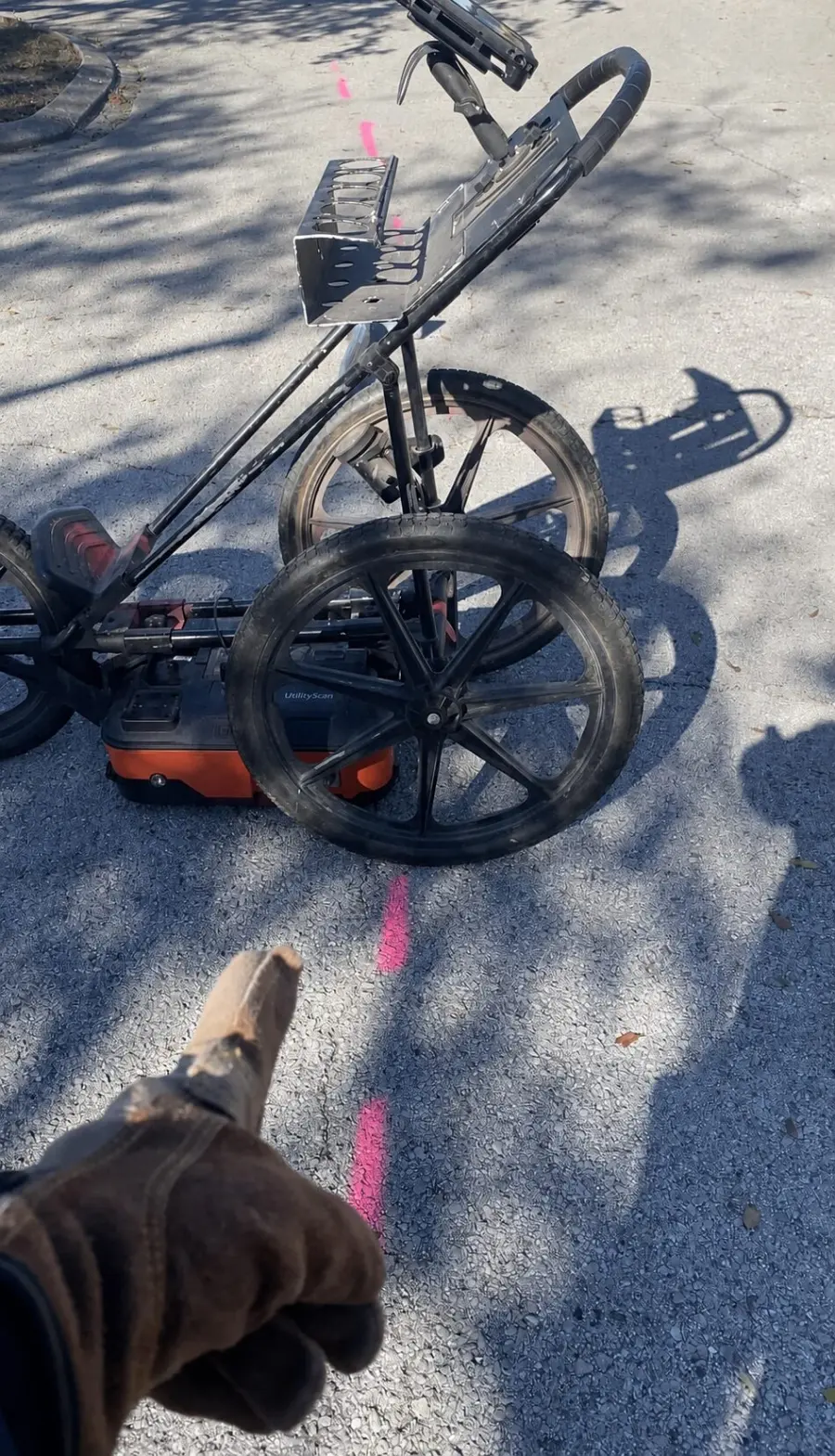
The crossings are the risk
Directional boring avoids open trench, which also means nobody sees a conflict until it is hit. On commercial sites and inside communities, much of what a bore crosses is private: site lighting, irrigation mains, fire lines, storm drains and conduit that no utility company marks.
GroundScout locates along the planned bore path and at the entry and exit pits, with both EM and GPR. Crossings are marked with depth estimates where the signal supports them, so the driller can plan the profile.
A strike on a bore costs more than the repair. The rig stops, the crew waits, and the owner wants to know why nobody marked the line.
What gets hit on these jobs
- Private electric and site lighting circuits
- Fire mains and private water lines
- Irrigation mains and reclaimed water lines
- Storm drains and sewer laterals
- Existing conduit, fiber and communications lines
What the locate involves
Send the bore plan: the entry pit, the exit pit and the planned path. GroundScout sweeps a corridor along that path and both pit areas with EM and ground penetrating radar.
Every line that crosses the path gets painted in its APWA color at the crossing, with a depth estimate where the signal supports one. Lines running close and parallel to the path get marked too, since a bore can drift.
The driller then has the crossings in hand to plan the profile before the head goes in the ground.
What a bore-path locate costs
Half day: $600
EM and GPR sweep of a shorter bore path and both pit areas, paint and flags, and a photo-documented field sketch.
Full day: $1,100
Long shots, several bores on one site, or crowded commercial corridors.
Maps and CAD: quoted
A drafted map of the crossings, or CAD files for the plan set, is priced with the job.
You get a flat quote before the visit. Send the plan with the length of each shot, and you hear back the same business day.
Why boring crews call GroundScout
- Crossings with depths. Depth estimates come where the signal supports them, so the profile can be planned around what is there.
- Both methods on every path. Plastic fire, irrigation and storm lines show on radar when EM has nothing to trace.
- Straight about limits. Deep targets and wet ground limit both methods. You hear which crossings were confirmed and which were not.
- Fast. Same-week scheduling is typical and next-day happens often.
- Trained, not just equipped. Florida does not license utility locators. GroundScout's locator holds a Certificate of Locating Competency from Staking University.
How it works, step by step
Call 811 first
It is free and it is the law in Florida. The utilities mark the lines they own.
Send the bore plan
Share the entry and exit pits, the planned path and the target depth if you know it.
Get a flat quote
You get a half-day or full-day price and a date. Same-week scheduling is typical.
Path and pits swept
EM and GPR along the corridor and at both pits.
Crossings marked
Paint and flags in APWA colors at each crossing, with depth estimates where the signal supports them.
Verify and bore
A photo-documented field sketch arrives the same week. Your crew verifies critical crossings before the head passes them.
When to schedule the locate
After the bore path is set and before the rig mobilizes. If the path changes on site, the new section needs its own sweep.
Marks on pavement last longer than marks on grass, but rain and traffic still wear them down. Book close to the bore date.
What affects the result
Depth matters most. EM reaches about 10 to 15 feet on a traceable conductor. Radar usually reads 4 to 8 feet in Tampa Bay soil, and less in wet clay. A line deeper than that sits below what a surface locate can confirm.
Crowded corridors and reinforced pavement also limit the read. You are told which crossings were confirmed and which were not.
Questions from boring and drilling crews
Do you provide depths for bore crossings?
Depth estimates are provided where signal quality and site conditions support them. Critical crossings should still be verified by potholing before the bore.
Do you pothole?
No. GroundScout locates and marks. Potholing or vacuum excavation is done by your crew or another contractor.
How deep can you locate a crossing?
EM locating typically reaches 10 to 15 feet on a traceable conductor. GPR depth depends on soil and is usually 4 to 8 feet in Tampa Bay conditions.
How much does a bore-path locate cost?
A half day is $600 and a full day is $1,100. Long shots or several bores on one site can take the full day. You get a flat quote before the visit.
What do I get at the end?
Paint and flags at every crossing, plus a photo-documented field sketch the same week. A drafted map or CAD file is available when the project needs one.
How fast can you get to the site?
Same-week scheduling is typical and next-day happens often. Call instead of emailing if the rig is already on site.
Service areas
GroundScout works across Hillsborough, Pinellas, Pasco, Polk, Manatee and Sarasota counties and the Orlando area. Local pages: Tampa, St. Petersburg, Clearwater, Largo, Palm Harbor, Brandon, Riverview, Plant City, Lutz, Wesley Chapel, Land O' Lakes, New Port Richey, Lakeland, Winter Haven, Bradenton, Lakewood Ranch, Sarasota, Venice and North Port.